
Posted
Cbg vs thc
CBG vs THC, compared as compounds and as regulated substances
One enzyme reaction separates the two molecules. In Canadian law the distance is far greater: THC is the compound the rules are measured in, and CBG is not named at all.
Most of the distance between CBG vs THC in Canadian law comes down to one fact. THC is the compound the rules are written in. The Cannabis Regulations use it as the unit for package limits, for the symbol on the front of a package and for the figures a label must state. CBG does not appear in them once. Chemically, the gap is much smaller: one enzyme reaction, two hydrogen atoms and a ring.
In this article:
One enzyme between them
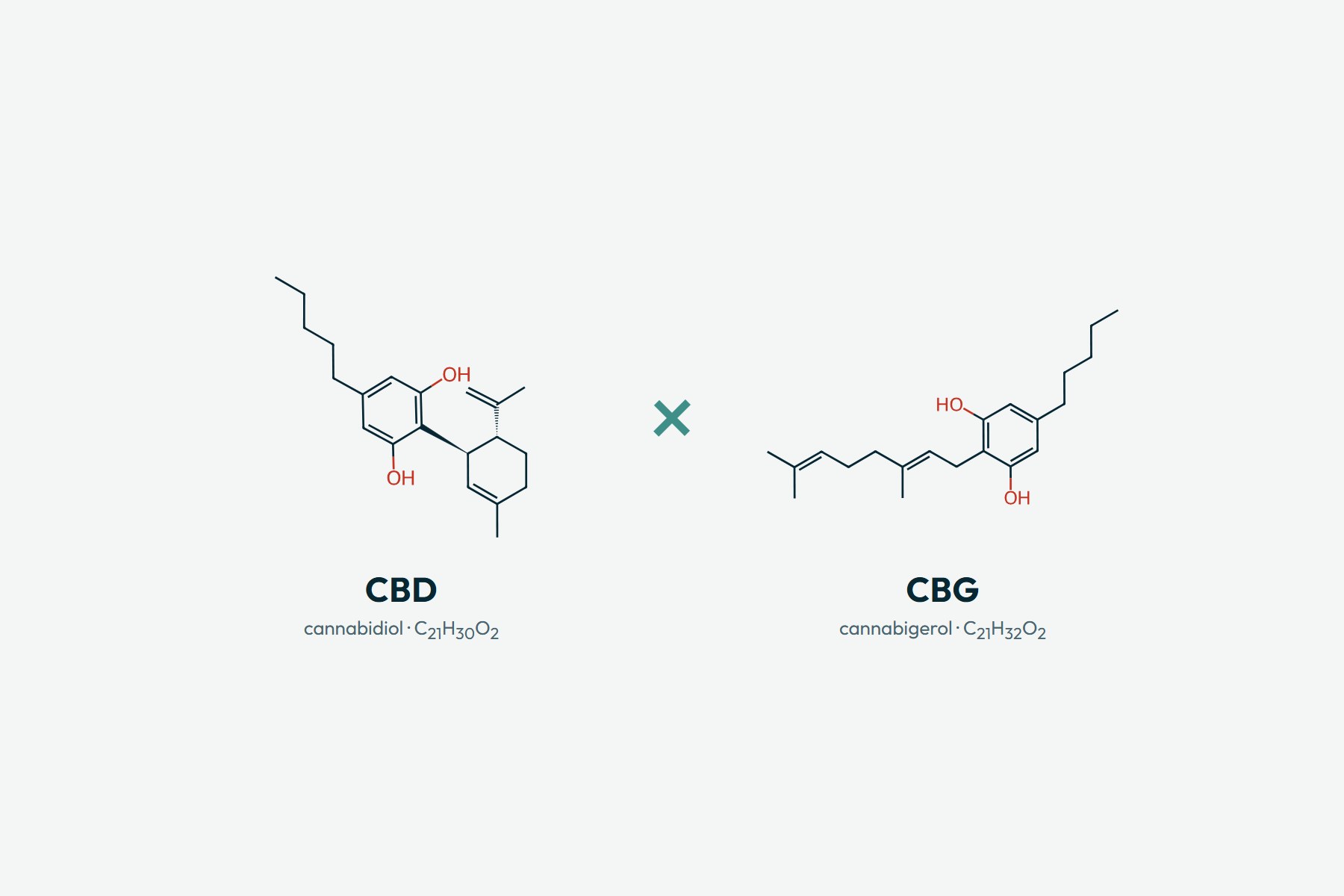
Both compounds start as cannabigerolic acid, or CBGA, the first cannabinoid in the pathway and the precursor of the others. How CBGA is assembled, and how it branches three ways, is set out in our post on CBG vs CBD. For this comparison only one branch matters.
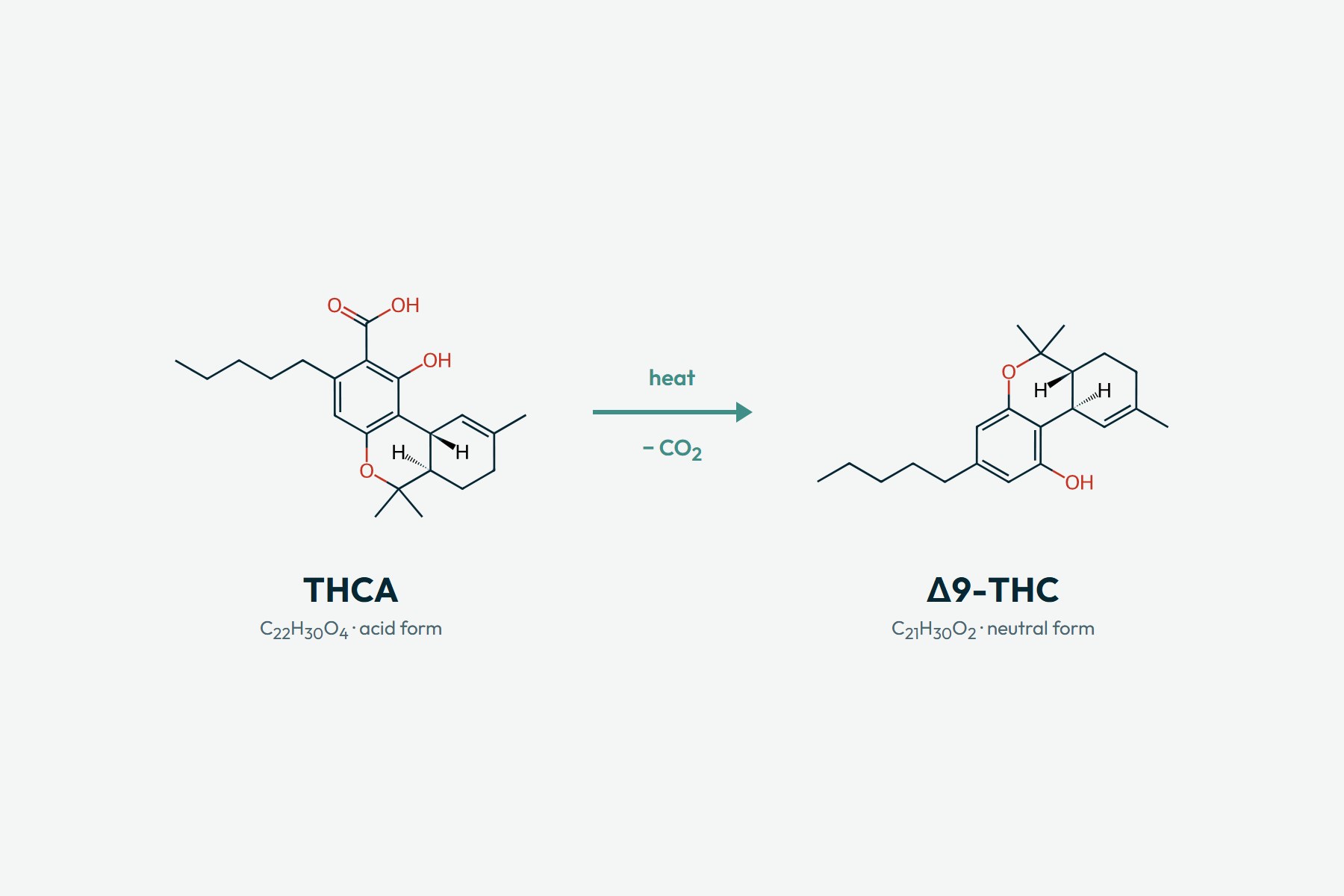
THCA synthase converts CBGA into tetrahydrocannabinolic acid, THCA. The 2004 study that first cloned the enzyme describes the reaction as an oxidative cyclisation, and showed that the enzyme carries a bound FAD cofactor that the reaction depends on (Journal of Biological Chemistry, 2004). Both acids later lose their carboxyl group as carbon dioxide when heated, which leaves the neutral compounds, CBG and THC. That step, and why it is finished before an input reaches production, is covered in decarboxylation explained.
CBG vs THC, atom by atom
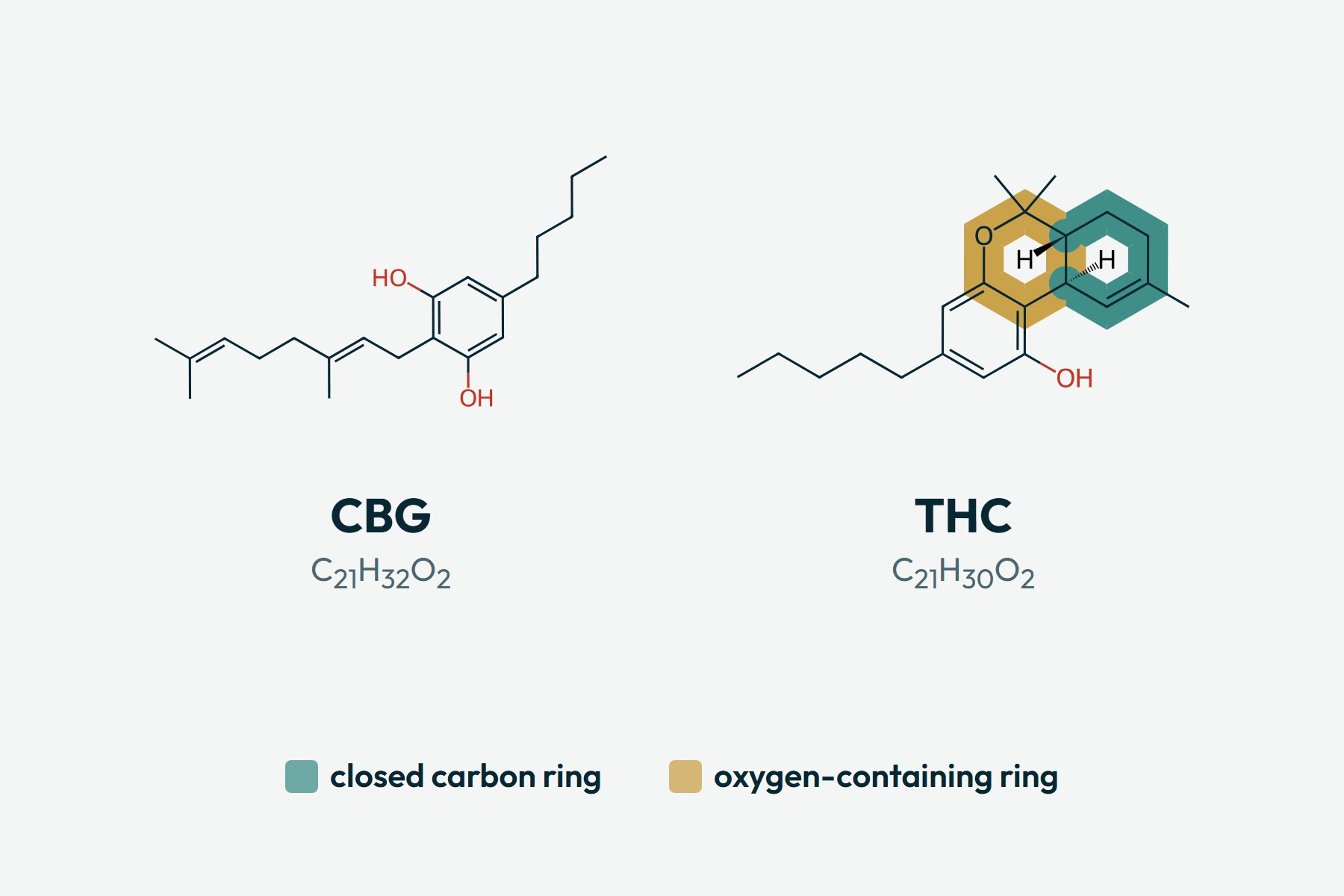
CBG is the open form. PubChem gives its formula as C21H32O2 and its molar mass as 316.5 g/mol (PubChem: cannabigerol). Its systematic name describes it exactly: a benzene ring carrying two hydroxyl groups and a five-carbon pentyl tail, with a ten-carbon terpene chain attached and left unclosed. With no ring in that chain, PubChem records no defined stereocentres.
THC is the same skeleton folded twice. Its formula is C21H30O2 and its molar mass 314.5 g/mol (PubChem: delta-9-tetrahydrocannabinol). The terpene chain has closed into a six-membered carbon ring. Then one of the two hydroxyl oxygens has been drawn into a second ring that bridges back to the aromatic core. The result is a fused three-ring system, which is what "benzo[c]chromene" in its systematic name refers to.
Three differences follow, and each one is measurable. THC has two fewer hydrogen atoms. It has one free hydroxyl group where CBG has two, so PubChem counts one hydrogen-bond donor for THC against two for CBG. And THC has two defined stereocentres, given as 6aR and 10aR, which fix its three-dimensional shape. CBG, with its open chain, has none.
Put side by side, CBG vs THC is a comparison between a flexible open chain and a rigid ring system built from almost the same atoms. On paper that looks small. In a formulation it is not: shape and polarity govern how a compound dissolves and how it holds up, so a formulator works with the two as separate inputs, each with its own specification.
How the law classifies each
At the level of the Cannabis Act, the distinction disappears. Schedule 1 covers the phytocannabinoids produced by or found in the cannabis plant, and also any substance identical to one of them, regardless of how that substance was obtained. CBG and THC are both cannabis, whether extracted or synthesised, and both may be handled only as the Act allows.
The Cannabis Regulations are where the two part company. They define THC precisely, as delta-9-tetrahydrocannabinol, and then use it as the measure for a series of fixed limits:
- Section 102.7: edible cannabis must not contain more than 10 mg of THC per immediate container.
- Section 101.2: a cannabis extract must not contain more than 1,000 mg of THC per immediate container.
- Section 123(1)(f): a product containing THC at a concentration greater than 10 μg/g must carry the standardized cannabis symbol.
- Section 132.18: the label of an edible in discrete units states the THC each unit and the whole package could yield, under "Total THC per unit" and "Total THC".
- Section 90: every lot or batch is tested for THC, together with THCA, CBD and CBDA.
- Section 99: THC or THCA must not be added to dried or fresh cannabis.
Every one of those THC figures is measured taking into account the potential to convert THCA into THC, which the Regulations define as the maximum amount of THC that would be obtained if the THCA converted with no further degradation. The enzyme product upstream therefore counts toward the limit downstream, converted or not. The chemistry in the first half of this post is written straight into the law.
CBG has none of this. There is no CBG ceiling, no symbol threshold, no prescribed label line and no named test. As our CBG vs CBD post notes, a CBG figure on a Canadian label exists because the licence holder chose to measure and declare it. It is still bound by the Act's general prohibition on anything false, misleading or likely to create an erroneous impression about composition or concentration, and its accuracy rests on the licence holder's own laboratory work.
What this means in a formulated product
For a manufacturer, CBG vs THC is two inputs with two different regulatory weights. THC sets the ceiling for the whole package and decides what the front panel must carry. CBG adds a declared quantity that has to be specified, measured and held to the same standard of accuracy, without a regulation that prescribes how. Our cannabinoid inputs are sourced from licensed suppliers and verified on receipt, and cannabinoid content is verified by laboratory analysis on every lot.
What either compound does is a different question, and this post does not answer it. A licensed producer in Canada does not make claims about what a cannabinoid does, and a manufacturer is not in a position to describe individual responses in any case. What we can state is what each molecule is, how the enzyme step separates them, and how the law measures each.