A number printed on a legal cannabis package is not an estimate, a target or a recipe value. It is the result of a laboratory analysis of the specific lot in that package, and the Cannabis Regulations make that analysis a condition of sale. Section 89 says it plainly: a licence holder must not sell a cannabis product unless the testing requirements in the sections that follow it have been met.
That one sentence organises everything else. Cannabis testing in Canada is not a quality programme a producer chooses to run. It is a gate that sits between a finished lot and every channel it could leave by.
What the Cannabis Regulations require to be tested
The cannabis testing requirements are short, and they are worth reading in the original on the Justice Laws website. For an edible product there are three things to understand.
Cannabinoid content, on every lot
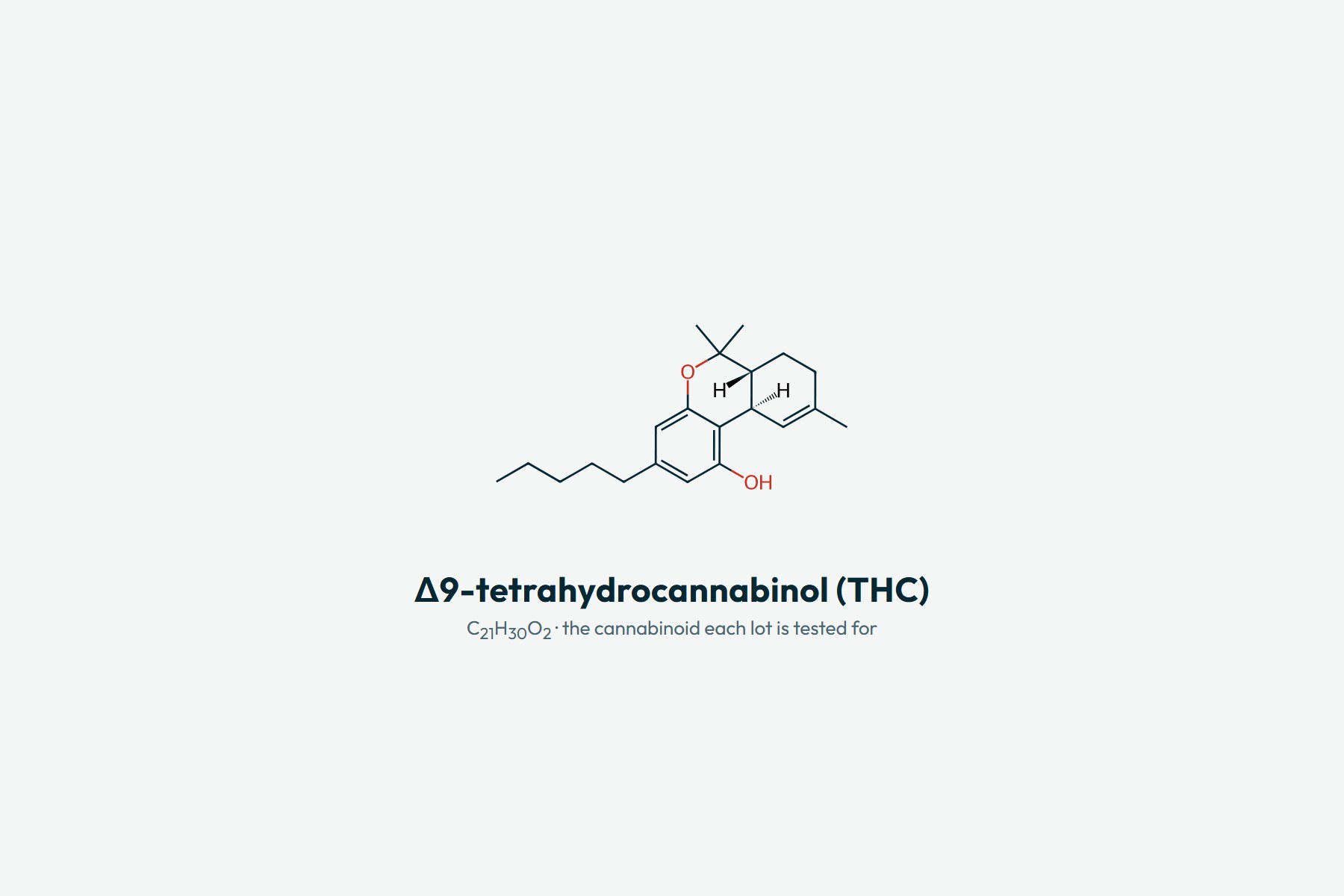
Under section 90, the quantity or concentration of THC, THCA, CBD and CBDA must be tested on each lot or batch that is or will become a cannabis product. The test is run on the cannabis in its final form, either before or after it is packaged and labelled. For a chocolate, that means the moulded, set piece, not the liquid batch and not the extract that went into it.
The timing matters. Once chocolate sets, whatever distribution existed in the batch is fixed, so the only measurement that tells you what a piece contains is a measurement of the piece.
Contaminants, at the point they could enter
Section 91 covers microbial and chemical contaminants. For most product classes it applies to the finished lot. For edible cannabis the regulation is built differently: the testing applies to the cannabis used to produce the edible, and it must be conducted after the last step in production where contaminants could have been introduced or concentrated.
The limits are not set by the producer. Section 94 says cannabis used to make an edible must sit within generally accepted tolerance limits for human use, drawn from the publications referred to in Schedule B to the Food and Drugs Act and appropriate for a product that is to be ingested. The same section requires residues of pest control products on that cannabis to fall within the maximum residue limits set under the Pest Control Products Act.
What does not apply to edibles
Some cannabis testing requirements are written for other formats. Dissolution and disintegration testing, under section 95, applies to discrete units shaped like conventional dosage forms, and the regulation states that it does not apply to edible cannabis. The per-unit THC limit in section 96 carries the same exception, because edibles are governed by a separate cap: no more than 10 mg of THC per immediate container under section 102.7.
How the testing itself is done
Section 92 sets the method for every test above. Cannabis testing must use validated methods, on a representative sample of each lot or batch. A portion of that sample must be kept for at least one year after the last sale of any part of the lot, in a quantity large enough to repeat both the contaminant determinations and the cannabinoid measurement.
That retained portion is easy to overlook and it is one of the more consequential details. It means the lot can be checked again long after it has left the building, against the same material the original result came from.
The analysis is carried out by a laboratory operating under a licence for analytical testing, a separate class that authorises possessing cannabis for the purpose of testing it. Section 23 requires each such laboratory to retain a head of laboratory who works at the licensed site and is responsible for the testing under sections 90 to 91.1. Accountability for the result sits with a named role inside a licensed lab, not with whoever submitted the sample.
Lot release: who decides a lot can leave
Passing cannabis testing is necessary. It is not the decision. Section 19 requires every processing licence holder to retain a quality assurance person with the training, experience and technical knowledge for the requirements that apply to their class of product. Where that person is not qualified for edible cannabis specifically, the processor must retain a second individual who is. The quality assurance person is responsible for assuring the quality of the cannabis before it is sold.
Section 88 makes that concrete for processors. The methods used to produce, sample and test product must be approved by the quality assurance person before they are put into use, and every lot or batch must be approved by that person before it is sold. The order is fixed: the method is approved first, the lot is tested by it, and only then is the lot released.
That is the sequence we work to. A sample from each lot goes to a licensed analytical laboratory, every lot is laboratory tested, and a quality assurance person releases it only after the results are in. Product does not ship on commercial judgement alone. Formulation, production and quality sit in the same building in Thunder Bay, Ontario, and the full path from formulation to released lot is set out on our craft manufacturing page. The wider obligations a licence carries are covered in what a Health Canada licence requires of a processor.
How cannabis testing connects to the label
The label is where the testing becomes public. A declared figure of THC or CBD on an edible is held to a variability limit under section 97(2), and the tolerance narrows as the declared quantity rises:
- 2 mg or less: no less than 75% and no more than 125% of the declared amount
- More than 2 mg and up to 5 mg: 80% to 120%
- More than 5 mg: 85% to 115%
The wider band at low doses is not leniency. It reflects how hard it is to measure, and to manufacture, a very small quantity of a compound evenly across a solid piece. At 1 mg per piece, a formulation that is slightly uneven in the batch shows up directly in the analysis.
The lot number on the package is the link between the two. It identifies the production run, and that run is the one the laboratory analysed, the quality assurance person released, and the retained sample came from. The document that records those results is the certificate of analysis. How to read one is explained in reading a certificate of analysis for an edible product. We do not publish ours; the record is held on file as part of our lot documentation.
What a person can take from all of this is narrow and exact. A declared figure on a legal edible came from cannabis testing of that lot, under validated methods, by a licensed laboratory, and the lot was released by a qualified person accountable under the regulations. That is the information the label exists to carry.
Next: Reading a certificate of analysis for an edible product
← All posts