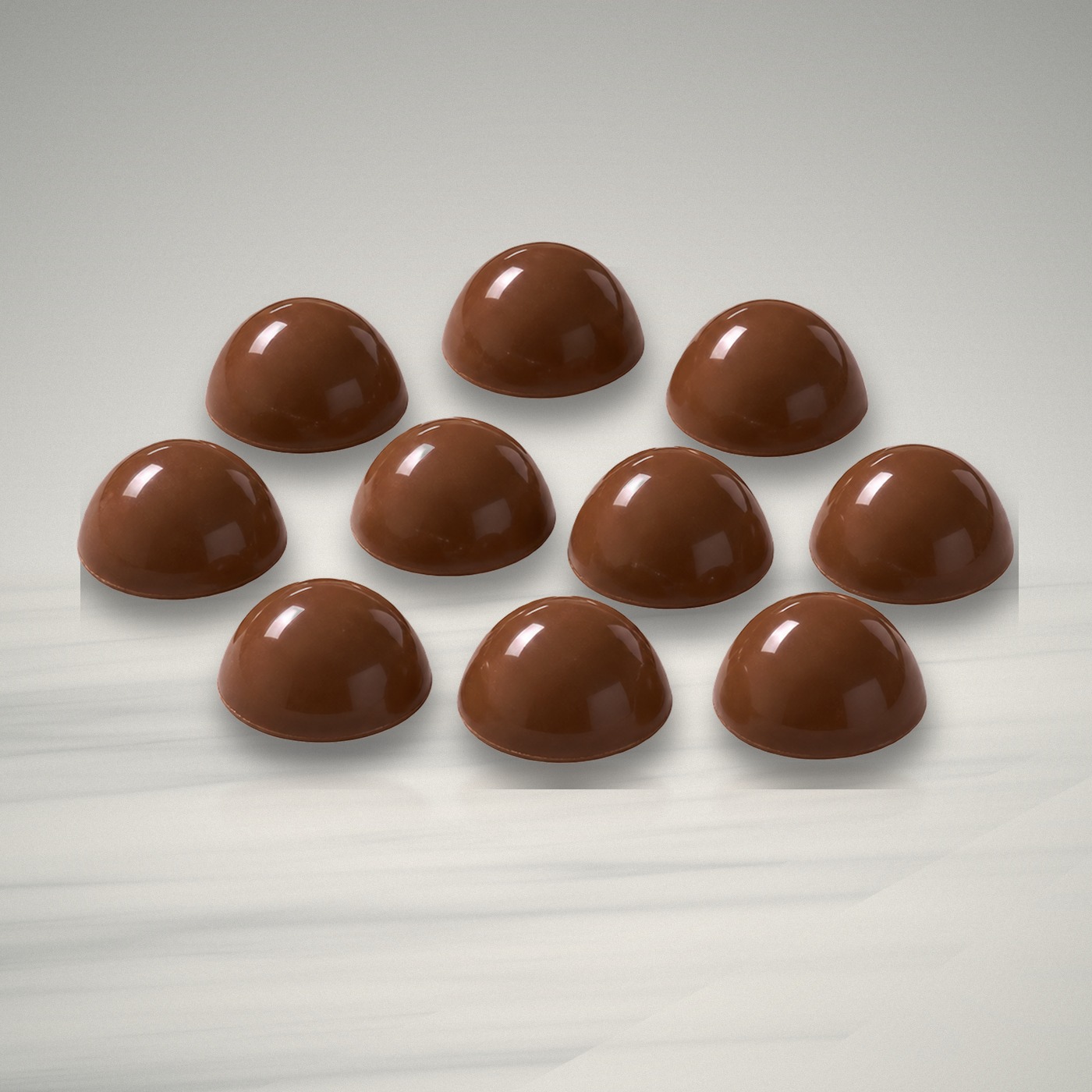
Most of what is written about tempering describes chocolate as one material. It is not. Dark chocolate has essentially one fat in it. Milk chocolate has two, cocoa butter and milk fat, and they do not crystallise the same way. Nearly every difference in tempering milk chocolate follows from that.
The general case is covered in why chocolate is a delivery system: cannabinoids follow fat, and cocoa butter has to be steered into the right crystal form. This post goes one level down, into what milk fat does to that crystal system and why it matters for a dosed product.
Six crystal forms, one target
Cocoa butter is polymorphic. The same fat can solidify into several different crystal structures, each with its own melting point and stability. The standard classification comes from a 1966 study in the Journal of the American Oil Chemists' Society, which identified six forms and numbered them I to VI in order of increasing melting point. The same study concluded that Form V is the usual state of cocoa butter in chocolate.
Form V is the target for a reason. A 2011 review of industrial tempering from the University of Ghana gives its melting temperature as 32 to 34 °C, and describes it as the form that gives a stable, glossy, well-contracted solid with a longer shelf life. The lower forms melt at lower temperatures and are unstable: given time they convert towards more stable forms, and the conversion shows up on the product.
Tempering is the method for getting Form V and only Form V. The chocolate is fully melted to erase every existing crystal, cooled under shear until crystals begin to form, then warmed slightly so that the unstable lower forms melt out while Form V seed crystals survive. Those seeds then template the rest of the fat as it sets. Every step is a temperature decision, and the right temperatures depend on what is in the fat phase.
What milk fat does to the fat phase
Milk fat is a different material. It is a mixture of many fats that melt at different temperatures, so it softens gradually over a range rather than melting sharply as cocoa butter does, and at room temperature it is soft rather than hard. When the two are blended, the milk fat does not join the cocoa butter crystal lattice cleanly. It dilutes it.
A 1996 paper in the same journal describes the softening this causes as coming from two sources: simple dilution, and a slight eutectic interaction between the two fats. A eutectic blend is one that is softer, and melts lower, than either fat alone would suggest from its proportion. The practical result is a fat phase that crystallises less readily.
That has measurable consequences for tempering milk chocolate. A technical paper presented at the 52nd PMCA Production Conference in 1998 reported cooling-curve data for cocoa butter and milk fat blends: as the milk fat share rises, the temperature at which crystals start to form falls, and the crystallisation rate slows. The same paper set out what follows in production:
- The higher the milk fat content, the longer tempering takes.
- The blend needs lower tempering temperatures.
- Product needs a longer dwell in the cooling tunnel, because the fat sets more slowly.
- Tempered dark chocolate can be held at about 32 °C (90 °F); milk chocolate should be held at about 31 °C (88 °F), because of the milk fat.
A degree sounds small. Against a Form V melting range only two degrees wide, it is the difference between keeping the seed crystals and losing them. Run a milk chocolate at dark chocolate temperatures and the seed melts out; the batch is no longer tempered, even though nothing about it looks different in the kettle.
What goes wrong, and what it looks like
Two failures account for most problems in tempering milk chocolate, and both are crystal problems rather than recipe problems.
Bloom
Fat bloom is a pale, dull film on the surface. It forms when fat that did not crystallise in Form V migrates and recrystallises at the surface, or when the crystal structure shifts to a more stable form during storage. The University of Ghana review states plainly that under-tempering induces fat bloom. Temperature cycling in storage makes it worse.
Milk fat cuts both ways here. The PMCA paper notes that small amounts of milk fat inhibit bloom, and the 1996 paper found that higher-melting fractions of milk fat sharply reduced bloom while softening the chocolate less than whole anhydrous milk fat. At higher proportions, though, the softening and slow crystallisation take over and the fat phase becomes harder to hold in Form V at all.
Soft set
The second failure is a product that never sets properly. If too little Form V seed survives, or the chocolate leaves the cooling stage before the slower milk fat blend has finished crystallising, the result is soft, releases poorly from the mould and does not hold its dimensions. Over-tempering is a failure too: the same review links it to increased hardness and reduced gloss. The window is narrow on both sides.
Why the dose cannot be solved separately
A cannabinoid extract is itself an oil. Added to milk chocolate, it joins a fat phase that is already diluted by a fat that will not crystallise with the cocoa butter. The mechanism the 1996 paper describes for milk fat, softening by dilution, is the same mechanism an extract brings with it. Tempering milk chocolate that carries an extract is therefore a third-fat problem, not a two-fat one, and the temperatures and dwell times that suit the plain chocolate are a starting point rather than an answer.
This is where tempering and dose distribution meet. The extract has to be evenly dispersed through the fat phase before the batch is moulded, because once the chocolate sets, the distribution is fixed. But the fat phase it is dispersed into also has to crystallise correctly, in the time the line allows, or the units bloom or set soft. A method that disperses the extract well and disturbs the temper fails. So does a temper that holds and a dispersion that does not. Each has to be developed against the other, so we handle them as one piece of work. The reasoning behind building the extract into the cocoa butter first is set out on our formulation science page.
What can be verified is the outcome. Cannabinoid content is verified by laboratory analysis on every lot, and formulation, production and quality sit in the same building in Thunder Bay, Ontario. Tempering milk chocolate well is what makes the declared figure on each unit something the lot result can confirm.
Next: The engineering behind a one-milligram dose
← All posts