
Posted
Cannabis edible regulations canada
Cannabis edible regulations Canada, mapped from product to package
The rules for an edible are spread across the Cannabis Act and a dozen parts of the Cannabis Regulations. Read in order, they form one sequence with a gate at every step.
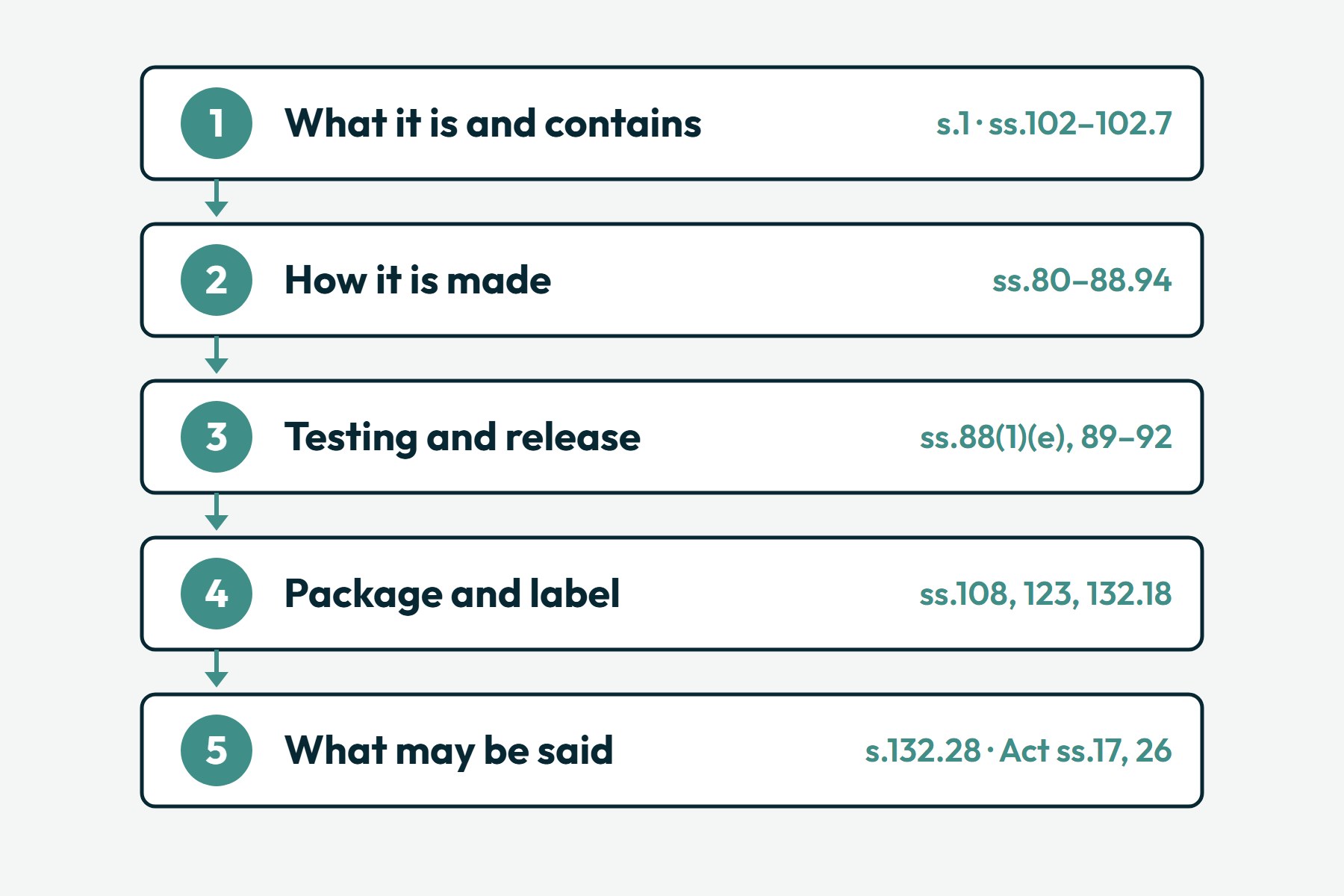
There is no single document that holds the cannabis edible regulations Canada enforces. They are spread across the Cannabis Act and roughly a dozen parts of the Cannabis Regulations, and each part answers a different question: what the product may be, how it may be made, how it is checked, how it is packed, and what may be said about it. Read in that order, they stop looking like a list and start looking like a sequence. A product moves through it from the definition to the shelf, and there is a gate at every step.
What follows is that sequence, kept short. Where we have already written about a stage in depth, the link goes there instead of repeating it. Section numbers are from the consolidated Cannabis Regulations on the Justice Laws website, current to 19 October 2026.
In this article:
What counts as an edible, and what it may contain
Section 1 of the Regulations defines edible cannabis as a substance or mixture containing cannabis that is intended to be consumed in the same manner as food. It is one of the classes listed in Schedule 4 to the Cannabis Act, alongside dried cannabis, extracts and topicals, and the class decides which rules apply from then on. A chocolate made with cannabis is edible cannabis, and so is anything else made to be eaten in the way food is.
Inside the edible class, the content rules are narrow:
- Ingredients may only be food and food additives (s.102(1)).
- Caffeine is allowed only from ingredients that naturally contain it, up to 30 mg per immediate container (s.102.2).
- Ethyl alcohol may not exceed 0.5% w/w (s.102.3).
- THC may not exceed 10 mg per immediate container (s.102.7).
- Where a container holds several units, their properties, including size, must be consistent (s.98.1).
Two more rules decide what sort of product can exist at all. Section 102.4 prohibits selling an edible whose unopened container must be kept at or below 4 °C to prevent contamination, so anything that needs refrigeration is out. Section 102.5 prohibits a hermetically sealed container if any component has both a pH above 4.6 and a water activity above 0.85. The Act adds a rule about the product itself, not only its package: section 31 prohibits selling cannabis whose appearance, shape or other sensory attribute could reasonably be believed to appeal to young persons. How the 10 mg cap and the label figures work together is set out in the Health Canada cannabinoids rules for edible cannabis.
How it must be made
Part 5 of the Regulations, on good production practices, covers every activity from production to testing. Each one runs under written standard operating procedures (s.80), in buildings and on equipment built to prevent contamination (ss.84 and 86), under a sanitation program (s.87), with temperature and humidity held at levels appropriate to the work (s.88.2).
Edibles carry obligations on top of that. The processor must identify and analyse the biological, chemical and physical hazards in its production and control them with measures shown by evidence to be effective (s.88.93). It must keep a written preventive control plan setting out critical control points, critical limits, monitoring and corrective actions (s.88.94), and the quality assurance person must approve that plan before it is used (s.88(1)(d)). Cannabis may not be produced or packaged in a building where food for sale is also produced or packaged (s.88.3). Under the cannabis edible regulations Canada applies, an edible plant and a food plant are kept physically apart.
How it is checked, packed and labelled
No cannabis product may be sold until the testing requirements in sections 90 to 92 are met (s.89), and no lot or batch may be made available for sale until the quality assurance person has approved it (s.88(1)(e)). What is tested, on which material and by whom is covered in how cannabis testing works before a legal product reaches a shelf.
The immediate container must prevent contamination, carry a security feature showing it has not been opened, and meet the child-resistant standard in the Food and Drug Regulations (s.108). The label must name the processor and give its telephone number and email address, and state the class of cannabis, the brand name, the lot number, the recommended storage conditions and the packaging date (s.123). An edible in discrete units adds its net weight, the number of units, THC and CBD per unit and per container, an ingredient list, allergen information and a nutrition facts table (s.132.18). The rules on colour, branding and the warning box sit in the same part, and they explain most of what a legal package looks like.
What may be said about it
The last gate is language. Section 132.28 prohibits any representation on the product, package or label, including through a brand element, that could create the impression that health or cosmetic benefits may be derived from using it. The Act goes further. Section 26 prohibits a package or label that could appeal to young persons, that sets out an endorsement, however displayed, that depicts a person, character or animal, or that associates the product with a way of life. Section 17(1) prohibits promoting cannabis at all unless the Act specifically authorises it, which is why legal producers in Canada describe what a product is and how it was made, and stop there.
Seen as a whole, the cannabis edible regulations Canada has written leave very little to the manufacturer's discretion: what goes in, how it is made, how it is checked, how it is packed and what can be said are all fixed in advance. Our own work runs inside that sequence. Cannabinoid inputs are sourced from licensed suppliers and verified on receipt, formulation, production and quality sit in the same building in Thunder Bay, Ontario, every lot is laboratory tested, and product does not ship on commercial judgement alone.