
Posted
Cannabis excise stamp
The cannabis excise stamp: who applies it and what it proves
Almost everything on a legal package is set by Health Canada. The stamp across its seam is not. It comes from the tax system, it is issued by the Canada Revenue Agency, and it proves one thing exactly.
Almost everything printed on a legal cannabis package is there because Health Canada requires it. The cannabis excise stamp is the exception. It comes from the tax system, it is issued by the Canada Revenue Agency, and it does one job. Its presence says that duty has been paid on the product inside. It says nothing else, and the law is careful to keep it that way.
In this article:
What the stamp is
The stamp is created under the Excise Act, 2001, not the Cannabis Act. Section 158.03 allows the Minister of National Revenue to issue stamps to a cannabis licensee, and states their purpose: to indicate that cannabis duty and, where it applies, additional cannabis duty have been paid. The Minister may limit how many are issued, and the design and construction of the stamp are subject to the Minister's approval. Producing or supplying anything intended to pass for one is a separate offence under section 158.04.
A cannabis licensee, in this Act, is the holder of a licence issued by the CRA under section 14. That is a second licence, separate from the one Health Canada issues. The CRA states that a business must obtain it, as well as its Health Canada licence, before it begins producing or packaging cannabis products (CRA, cannabis excise duty framework).
The CRA's memorandum on the stamping regime, EDM6-1, is direct about the limits of the cannabis excise stamp. Its sole purpose is to show consumers, retailers and others that duty has been paid, and it cannot be used to meet any other packaging or labelling requirement. It is not a substitute for any line on the label.
What is on it
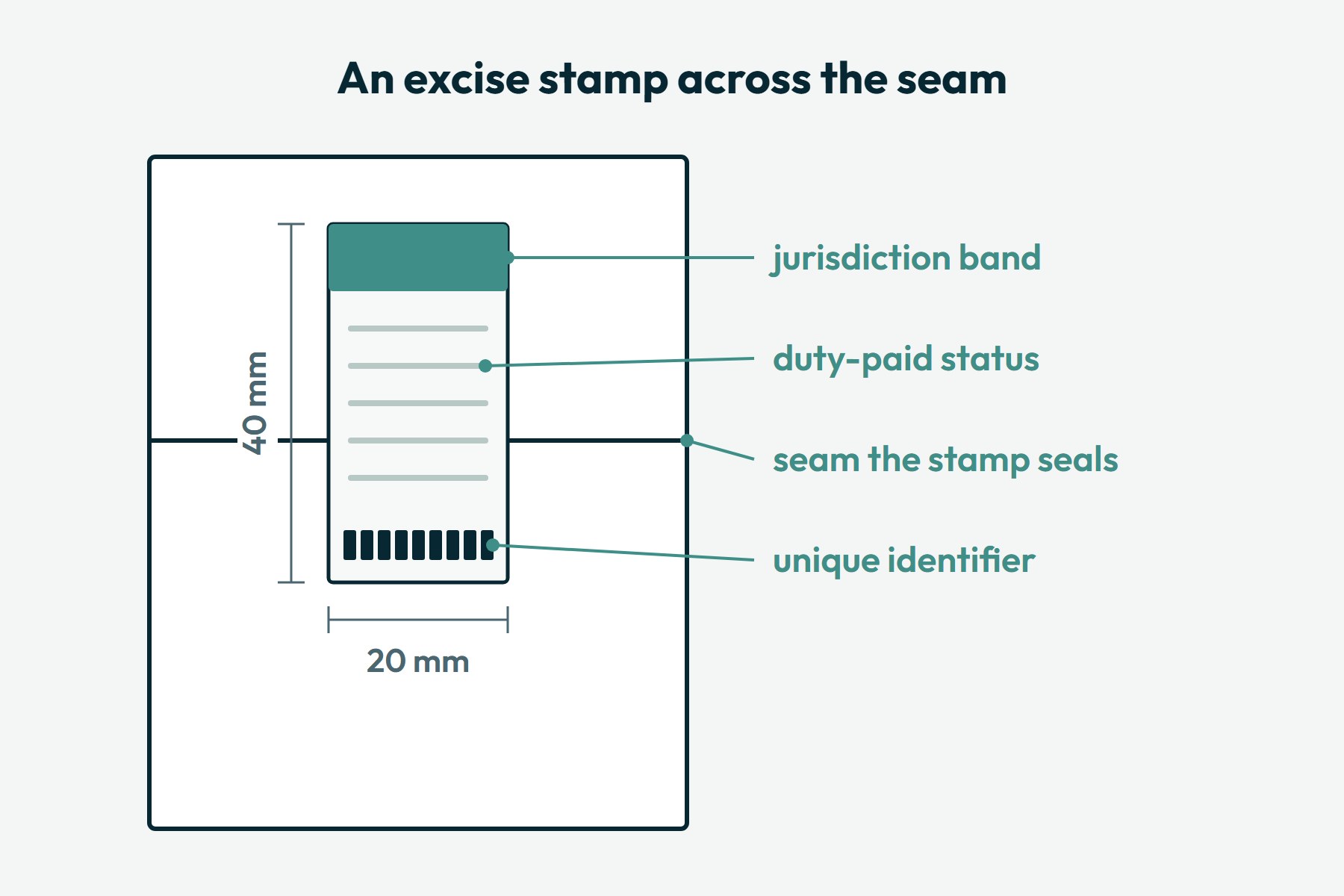
According to EDM6-1, every cannabis excise stamp measures exactly 20 mm by 40 mm and carries three visible elements:
- a jurisdiction indicator, with the province or territory's abbreviation and colour band;
- an identifier, nine positions long, unique to that individual stamp;
- the federal duty-paid status, which covers both cannabis duty and any applicable additional cannabis duty.
Each province and territory has its own colour, and the stamp on a package must match the jurisdiction where the product will be sold. The memorandum notes that additional cannabis duty applies in every province and territory except Manitoba, so for a product sold in Ontario the single stamp records both the federal and the provincial portion.
The CRA publishes four of the stamp's overt security features. An engraved intaglio image shows the letter C when the stamp is tilted slightly. A colour-shift ink moves from green to red as the viewing angle changes. Fine anti-copy line work does not survive photocopying. And an ultraviolet ink fluoresces under an ordinary black light. There are covert features too, which the CRA deliberately does not describe.
Who applies it, and when
Only a cannabis licensee, or an entity prescribed by regulation, may package or stamp a cannabis product (section 158.08). A licensee may not enter a product into the duty-paid market unless it is packaged, carries the prescribed information, and is stamped with a stamp issued to that licensee, either by the licensee itself or by another licensee where prescribed conditions are met (section 158.13).
The timing is fixed by where the product is. Section 158.09 prohibits removing a product intended for the duty-paid market from a licensee's premises unless it is packaged and stamped. EDM6-1 states the practical consequence: the licensee decides the province or territory of sale and applies the matching stamp before the product leaves. By the time a package is on the way to a retailer, the stamp is already part of it.
Where it goes is prescribed as well. The Stamping and Marking of Tobacco, Cannabis and Vaping Products Regulations say the stamp goes on the smallest package in which the product is sold to the consumer, and section 4.2 sets how it is affixed:
- in a conspicuous place on the package;
- in a manner that seals the package;
- so that the stamp remains affixed after the package is opened;
- without interfering with the stamp's security features;
- without obstructing any information an Act of Parliament requires on the package.
Sealing is the requirement that decides placement. The stamp has to sit where the package opens, and it has to survive that opening rather than come away with it.
What it proves, and what it does not
The cannabis excise stamp proves that duty was accounted for on that package. The Excise Act makes the reverse true as well: under section 158.14, the absence of a stamp is notice to everyone that duty has not been paid. Under section 158.11, nobody other than a cannabis licensee may sell, offer for sale, purchase or possess a cannabis product that is not packaged and stamped, subject to listed exceptions. The CRA's page for consumers describes an unstamped product as contraband.
One of those exceptions is a low-THC cannabis product. The Act defines it narrowly: a product made entirely of fresh cannabis, dried cannabis or a cannabis oil that is liquid at 22 ± 2 °C, no part of which can yield more than 0.3% THC by weight. An edible is none of those, so the exception cannot reach it: an edible entering the duty-paid market has to be stamped.
What the stamp does not prove is anything about the product itself. It does not certify the contents, the THC figure or the quality of the lot. Those belong to a different system: the label rules covered in why legal cannabis packaging looks the way it does, and the laboratory testing and lot release a processor completes before a lot can be sold. Our products are packaged to the labelling rules, with the excise stamp, the standardized cannabis symbol, the health warning, the lot number and the licence holder all present. Each answers a different question. The stamp answers only one: whether the duty was paid.