
Posted
Cannabis security clearance
Who needs a cannabis security clearance, and why the law requires one
A licence is issued to a business, but the Cannabis Regulations also screen the individuals who own, control and run it. This is who must be cleared, how the application works and what the screening is for.
A cannabis licence is issued to a business, but the business is not the only thing Health Canada screens. The Cannabis Regulations also require the individuals who own it, control it and run its key functions to hold a security clearance, each in their own name. The licence describes what may be done at a site. A cannabis security clearance answers a different question: whether the individuals in charge of that site can be trusted with it.
The rules sit in Part 3 of the Cannabis Regulations, sections 49 to 61, and in section 67 of the Cannabis Act, which gives the Minister the power to grant, refuse, suspend or cancel a clearance.
In this article:
Who must hold a cannabis security clearance
Section 50 is a list, and it is longer than most expect. For a licence for processing or sale, it covers:
- an individual who holds the licence personally;
- where a corporation holds it, its directors and officers, and any individual who exercises, or is in a position to exercise, direct control over it;
- the directors and officers of any corporation or cooperative that controls the licence holder, and the partners in any partnership that does;
- the responsible person under section 37, who has authority to bind the licence holder and is responsible for the activities conducted under the licence;
- the head of security under section 38, responsible for the physical security measures and the organizational security plan;
- for a processing licence, the quality assurance person under section 19, who approves each lot before it is sold;
- anyone designated as an alternate for those roles.
Cooperatives and partnerships have parallel lists, and one role specific to another licence class appears as well. The pattern holds throughout: the clearance follows control and accountability, not job title. A director who never enters the building needs one. So do the directors and officers of a company that controls the licence holder.
The list is not closed. Under section 67(2) of the Act, the Minister may specify any other person, by name or position, who performs activities related to a licence or has custody, management or control of the place where they happen. Section 51 limits who may apply: someone who already needs a clearance, someone who will need one if a pending licence application or business transaction goes through, or someone selected for one of the named roles. A change of ownership is therefore also a change in who must be cleared.
What the application involves
Health Canada's steps to apply start with fingerprints, taken at a Canadian police force, the RCMP or an accredited fingerprinting company for a certified criminal record check. The applicant then assembles:
- a birth certificate, any immigration document, and valid government-issued photo ID;
- details of any criminal convictions;
- every address, employer and educational institution over the past five years, with dates;
- information about a current spouse or common-law partner, and any in the past five years;
- time spent outside the country over the past five years;
- a signed consent and certification form.
The individual submits the application through Health Canada's Cannabis Tracking and Licensing System, and the licence holder's responsible person links it to the licence and pays the fee. Every cannabis security clearance is personal, but it is always held in respect of a licence.
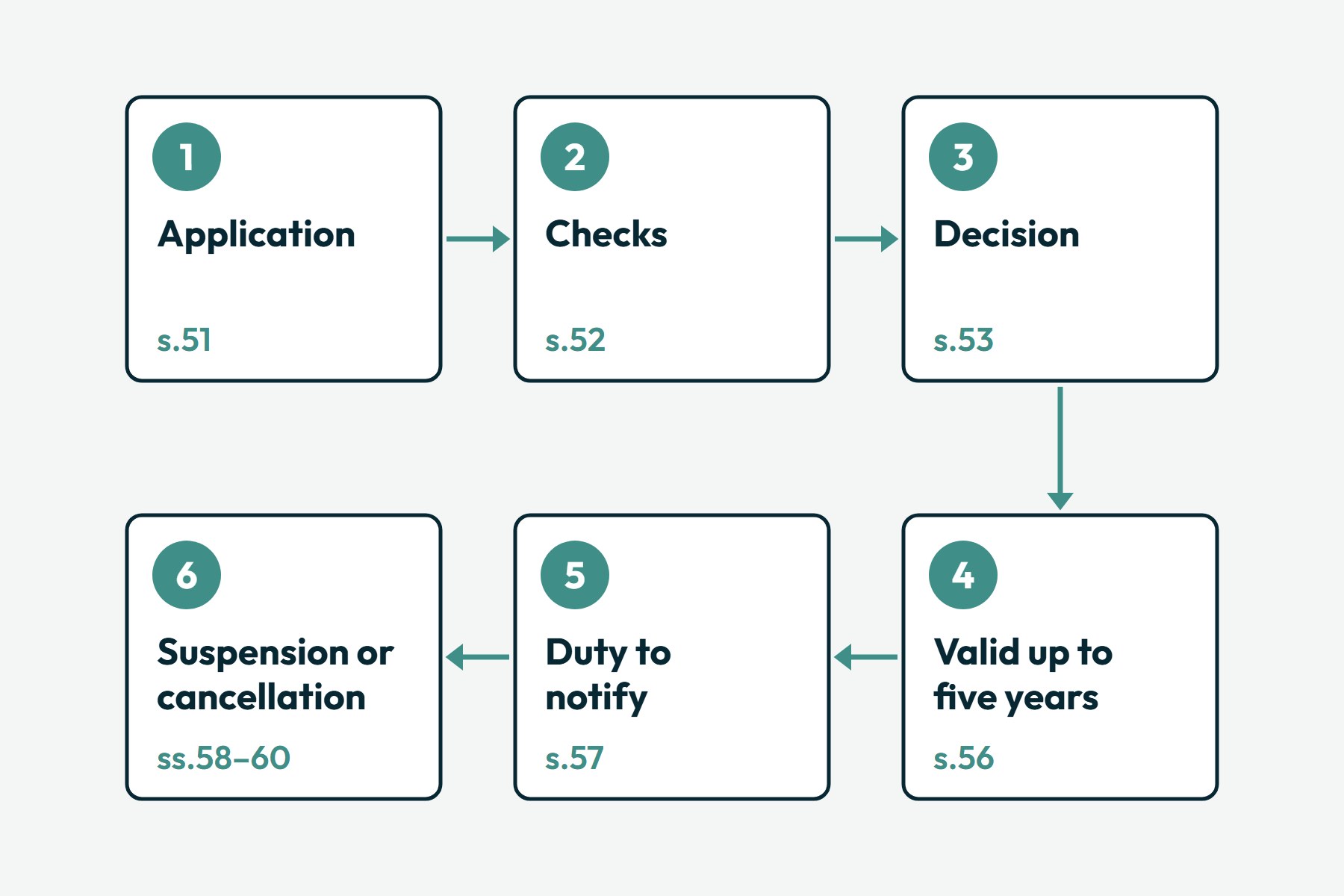
Section 52 sets out the screening. The Minister may, at any time, check the applicant's criminal record and the relevant files of law enforcement agencies, including intelligence gathered for law enforcement purposes. Health Canada's description of the process adds a foreign criminal record check where it applies, and says most applications take a few months, some rare cases over a year, and that the approval rate has been more than 95 per cent.
A refusal is not abrupt. Section 55 requires a notice with the reason and at least 20 days for written representations first. If the refusal stands, section 61 bars a new application for five years unless the circumstances behind it have changed.
What the Minister weighs, and for how long
Section 53(1) states the test. Before granting a cannabis security clearance, the Minister must determine that the applicant does not pose an unacceptable risk to the public, a risk the section says includes cannabis being diverted to an illicit market or activity.
The factors in section 53(2) show what that risk looks like: the seriousness, number, frequency and recency of relevant convictions; involvement with a criminal organization, or association with those who are; reasonable grounds to suspect the applicant could be induced to commit a harmful act; activities, financial ones included, that could undermine the controls on cannabis production and distribution; and any false or misleading information given to the Minister.
A clearance does not last indefinitely. Under section 56 the Minister sets its validity period according to the level of risk, to a maximum of five years, and Health Canada advises submitting a renewal within the six months before expiry. In between, section 57 requires a holder to notify the Minister without delay if they are charged with, or found guilty of, an offence under the Cannabis Act, the Controlled Drugs and Substances Act or the Criminal Code.
The Minister can act on that. Section 58 allows a suspension on reasonable grounds to believe the risk has become unacceptable, effective as soon as written notice is given, and the affected licence holder must be told too. Cancellation can follow only after a suspension and its representation period (section 60). Under section 62(7)(f) of the Act, a licence may itself be refused if a security clearance in respect of the application has been refused or cancelled.
Why the law requires it
The purpose section of the Cannabis Act explains the design. Among its stated aims are to provide for the licit production of cannabis to reduce illicit activities, and to deter those activities through sanctions and enforcement. A legal supply serves that purpose only if it stays legal. Physical security keeps product inside the site and lot records trace where it goes, but neither helps much if the individuals with authority over the site are the risk.
That is why section 50 reads the way it does. It reaches whoever could direct cannabis out of the regulated supply: those who own or control the licence holder, the individual who answers for the licence, the individual responsible for security and, at a processor, the individual who decides what may be sold. Each cannabis security clearance is granted on entry, carries a duty to report, and is re-examined at least every five years. The wider obligations of a processing licence are covered in what a Health Canada licence requires of a processor, and lot release in how cannabis testing works before a legal product reaches a shelf.
We are a federally licensed processor in Thunder Bay, Ontario, and Part 3 applies to us as it does to every processor. We do not describe the individuals at our own company or their clearances. The requirement is public. Who meets it, at any licence holder, is a matter between those individuals and Health Canada.