
Posted
Chocolate bloom
Chocolate bloom: fat bloom, sugar bloom and how production prevents both
A pale film on chocolate is the chocolate's own fat or sugar, recrystallised in the wrong place. This is what each kind is, what causes it, and which production conditions hold it back.
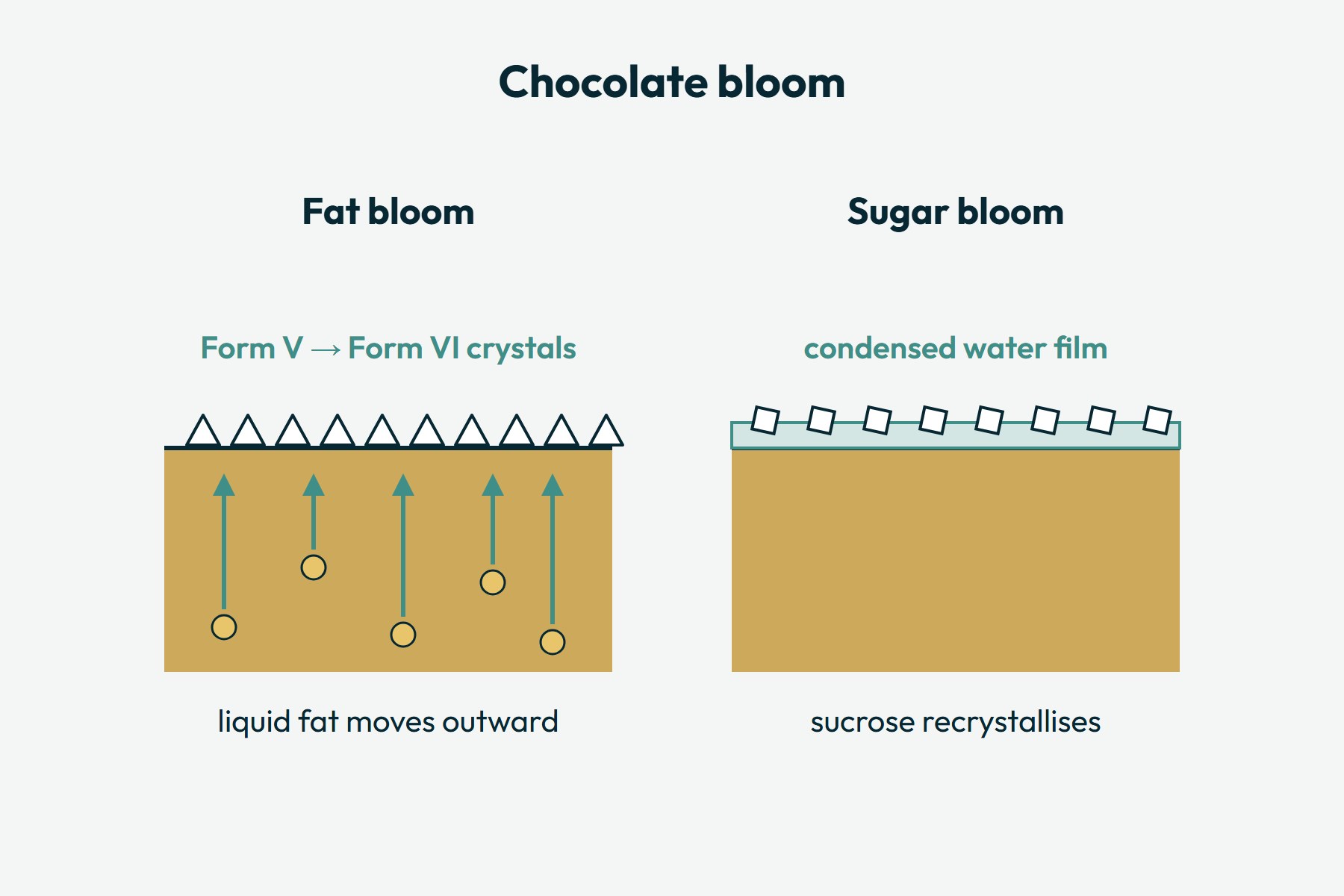
A white or grey film on chocolate is not something that has landed on it. It is the chocolate's own material, recrystallised in the wrong place. Chocolate bloom comes in two kinds, and they are different problems. Fat bloom is a crystal problem in the cocoa butter. Sugar bloom is a water problem at the surface. Each has its own cause, and each is held back by different conditions in production.
The science of the first is less settled than its familiarity suggests. A 2004 review in the European Journal of Lipid Science and Technology opens by noting that, despite decades of study, the specific mechanisms of fat bloom remain largely unknown. What is known is enough to manufacture against.
In this article:
What the white film is
The same 2004 review defines a bloomed surface by what it has lost: its initial gloss. The result ranges from a uniform dull grey to a marbled pattern, and from small white points to large white spots. In most cases what you are seeing is light. Fat crystals that have formed at the surface, in an orientation that scatters incident light instead of reflecting it evenly, make the surface read as pale.
The second kind of chocolate bloom has a different origin. A 2019 review in Molecules describes sugar bloom forming under humid conditions, when moisture condenses on the surface. Sucrose at the surface dissolves into that film of water, and when the water is removed the sugar recrystallises as a fine, dry layer. No fat is involved. The 2004 review sets sugar bloom aside for exactly that reason: it is a humidity problem, not a fat one.
What causes fat bloom
The 2004 review sorts fat bloom into four categories. All four are, in its words, a stability problem of fat crystals, at different scales.
Under-tempering, or melting after tempering
Cocoa butter can solidify in six crystal forms, and tempering exists to produce Form V. Our post on tempering milk chocolate explains the method. If too few Form V seed crystals survive, or a tempered piece is warmed enough to melt them, the fat crystallises uncontrolled into a less stable form. Within days it converts towards Form V or Form VI, and the crystals contract as they do. The review describes the white spots that follow as mainly sugar crystals and cocoa solids, nearly devoid of fat. This kind of chocolate bloom is the surface left behind when the fat pulls back.
Over-tempering
Too much seed, or seed crystals that are too large, produce a dull grey surface as the chocolate sets. Large cocoa butter crystals use up the liquid fat around them and leave a rough surface that diffracts light. This form appears at solidification and does not change with time.
Incompatible fats and fat migration
Some fat blends do not crystallise together, and the separate fats migrate to the surface on their own. Liquid fat can also move in from any adjoining fat phase, by diffusion and by capillary forces through the chocolate's pores. Once it arrives it dilutes the cocoa butter crystals, softens the structure and gives the fat room to recrystallise.
Storage bloom
The slow kind of chocolate bloom forms in chocolate that was tempered correctly. The review's account turns on two steps. First, temperature fluctuations, even very small ones, change how much of the fat is liquid. Liquid fat takes up more volume, so each warming pushes some of it outward, and on cooling not all of it is reabsorbed. Second, that liquid fat recrystallises at the surface in a more stable form. The 2019 review states the transition directly: in well-tempered chocolate, fat bloom can come from the change from Form V to the more stable Form VI.
How production prevents chocolate bloom
Because every type of fat bloom is a crystal problem, prevention is mostly crystal control, and most of it happens before the chocolate is ever packaged.
- Seed concentration. The 2004 review gives the seed crystal concentration at which chocolate is ready for moulding as 0.5 to 2% of total mass. Below that range the batch is under-tempered; above it, over-tempered.
- Seed crystal size. Smaller and more regular seed crystals give a chocolate with greater bloom resistance. Crystals that are too large tend to recrystallise in storage.
- Cooling rate. Cooling too fast can form unstable crystal forms and leave hair cracks and pores in the surface. Both open a route for liquid fat. Even heat release, from the inside as well as the outer layer, avoids that tension.
- Surface integrity. As long as the surface stays smooth, compact and free of cracks, liquid fat does not cross it, and bloom is delayed.
- Fat composition. Incompatible fat blends bloom readily. Milk fat works the other way: the 2019 review notes that it delays the Form V to Form VI transition.
Sugar bloom is controlled through moisture rather than crystals. The 2004 review notes that improper temperatures during cooling can deposit moisture on the product, which leads to sugar bloom.
A cannabis chocolate adds one consideration. A cannabinoid extract is itself an oil, and the 2004 review identifies liquid fat content as one of the factors that activates recrystallisation. That is part of why formulation and tempering are developed together rather than one after the other, as our formulation science page sets out.
What storage temperature does
Production sets the starting structure. Storage decides how long it holds. The 2004 review reports three ranges for chocolate. Storage below 18 °C inhibited storage bloom for over a year in one study. Between about 18 and 30 °C, below the melting point of Form V, bloom forms faster as the temperature rises. Above about 32 to 34 °C the cocoa butter partly melts and recrystallises uncontrolled on cooling, which is under-tempered bloom in a finished piece. Fluctuation matters too: temperature swings shorten the time before bloom appears and speed its spread.
How a sealed package should be kept at home is covered in safe storage for cannabis, and is not repeated here. From the manufacturing side, chocolate bloom is a record of a piece's thermal history, written in its crystals. Every lot we make is laboratory tested, and what the crystals record after that depends on the conditions the package meets.