
Posted
Cocoa butter melting point
Cocoa butter melting point: a range, not a number
Cocoa butter melts over a few degrees, and where those degrees fall depends on which of six crystal forms the fat is in. That decides how a moulded piece sets, releases and holds.
Ask for the cocoa butter melting point and you will usually be given one number, somewhere in the low thirties Celsius. The number is not wrong. It is incomplete. Cocoa butter can solidify into six different crystal forms, each of them melts across its own band of temperatures, and the bands overlap. Which form a moulded piece is in decides how it sets, how it leaves the mould and how it holds up afterwards.
In this article:
Three molecules make up most of the fat
Cocoa butter is almost entirely triacylglycerols, molecules built from a glycerol backbone carrying three fatty acid chains. Three of them dominate. POP, POS and SOS, named for the palmitic (P), oleic (O) and stearic (S) acids they carry, together account for more than 80% of the triacylglycerol content, according to a 2025 perspective on tempering from the University of Guelph (Crystal Growth & Design, 2025). All three share one layout: a saturated chain at each end and an unsaturated oleic chain in the middle.
That uniformity is why cocoa butter melts over a short span instead of softening gradually. A fat made of many different molecules melts piece by piece as the temperature climbs, each component letting go at its own point. A fat made mostly of three near-identical molecules lets go almost together. The same paper lists sharp melting behaviour among the properties cocoa butter gives chocolate. Milk fat is the contrasting case, a mixture of many fats that softens across a broad range, and what it does to the crystal system is covered in tempering milk chocolate.
The proportions are not fixed, though. The Guelph authors note that melting temperatures depend heavily on the exact triacylglycerol composition and on the minor components in a given cocoa butter, that the ranges of the forms overlap, and that each source needs its own characterisation. Tempering temperatures move with the origin of the fat for the same reason.
Six forms, six melting ranges
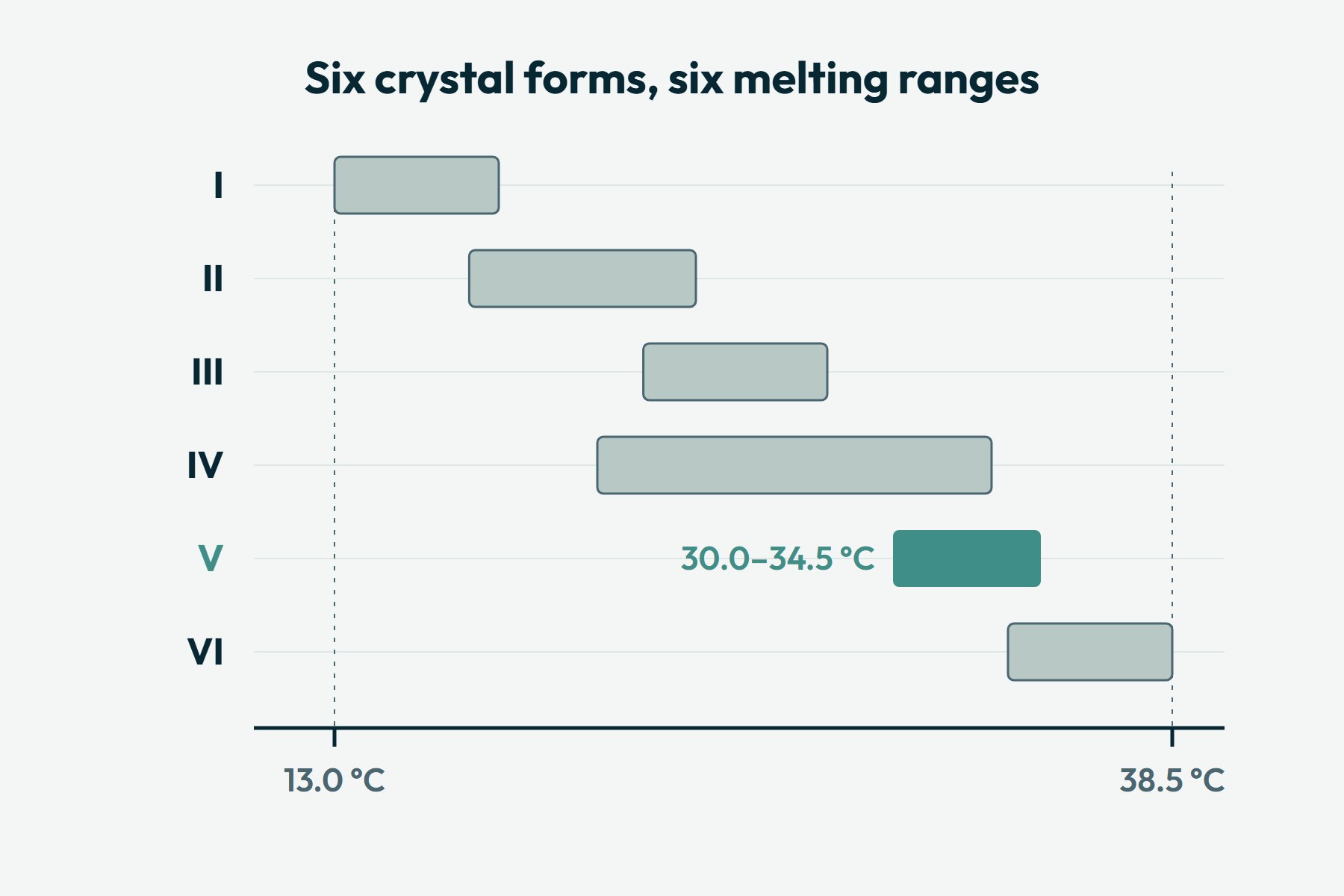
The same three molecules can pack into crystals in several ways. The standard scheme numbers six forms, I to VI, in order of increasing melting point. The Guelph paper compiles their ranges from earlier work:
- Form I: 13.0 to 18.0 °C
- Form II: 17.1 to 24.0 °C
- Form III: 22.4 to 28.0 °C
- Form IV: 21.0 to 33.0 °C
- Form V: 30.0 to 34.5 °C
- Form VI: 33.5 to 38.5 °C
Forms I and II are unstable and convert readily into higher forms. Forms III to V are metastable: they persist, but they are not the lowest-energy arrangement and will move towards one if conditions allow. Form VI is the only thermodynamically stable form, and it is the one associated with bloom and a brittle texture.
Form V is the target in chocolate manufacture. A 2011 review of industrial tempering from the University of Ghana gives its melting temperature as 32 to 34 °C and credits it with gloss, snap, contraction and longer shelf life (University of Ghana repository). The difference between that figure and the Guelph range is the source dependence in practice: two careful sources, two cocoa butters, a degree or two apart. So when someone quotes a single cocoa butter melting point, the useful follow-up is which form, and which fat.
What the range means for a moulded piece
In the mould, the form decides whether the piece comes out at all. Form V crystals contract as they set, which is the contraction that review lists, and contraction is what lets a set piece release cleanly from its cavity. The same review states that under-tempering induces fat bloom and that over-tempering increases hardness and reduces gloss. Both are failures of crystal form, not of recipe, and both are fixed at the moment the fat sets.
After the mould, the bottom of the Form V range matters more than the top. On the Guelph figures, Form V begins to melt at around 30 °C, and a piece does not have to melt through to change. The paper describes heating just below the melting point as bringing about a gradual, oil-mediated transformation from Form V towards Form VI, and temperature cycling in storage as causing repeated partial melting and recrystallisation. The visible result is bloom. A piece that has been warmed and cooled a few times can look different, and be in a different crystal form, without ever having been liquid.
For a dosed piece, this is where the fat and the formulation meet. Cannabinoids are lipophilic, so the cannabinoid sits in the fat, and in our formulation it is built into the cocoa butter phase before the chocolate is made. Once chocolate sets, whatever distribution existed in the batch is locked into the individual units, which is why the crystal state has to be right the first time. Tempering and moulding run under controlled temperature and humidity for that reason, and the reasoning behind building the extract into the fat is set out on our formulation science page.
The cocoa butter melting point, read properly, is a set of overlapping ranges that depend on the fat and on how it was crystallised. What can be verified is the outcome in the finished unit. Every lot we make in Thunder Bay, Ontario is tested by a third-party licensed analytical laboratory, and that result, not the temperature log, is what stands behind the figure on the label.