Posted
Thc label canada
THC label Canada: the THC information on a legal package, line by line
THC appears in more than one place on a legal package, and none of those places is a design choice. This is what each THC line says, how the Cannabis Regulations require it to be printed, and what it leaves out.
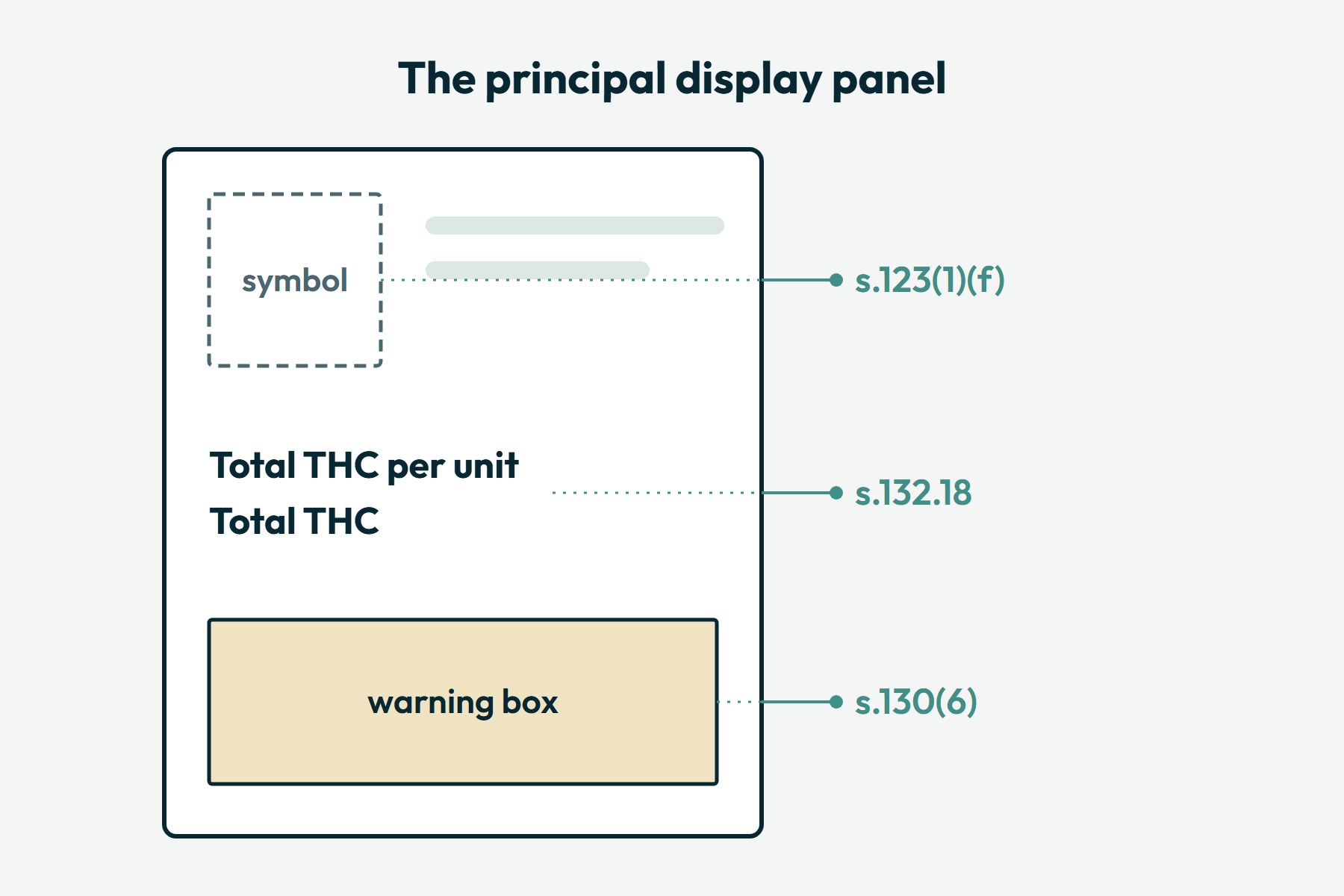
THC is printed on a legal Canadian package in more than one place, and none of them is a designer's decision. The figures, the type they are set in, the panel they sit on, the warning box beside them and the symbol above them are all fixed by the Cannabis Regulations. Read in order, the THC label Canada requires on an edible says a small number of things very precisely.
In this article:
The Total THC lines
For edible cannabis in discrete units, meaning separately formed pieces, section 132.18 of the Cannabis Regulations requires two THC figures, both in milligrams. One is preceded by "Total THC per unit". The other, preceded by "Total THC", covers the whole container. An edible that is not divided into units carries only the container figure, under section 132.19. How the two figures relate, and why the smaller one describes a single piece, is the subject of what 10mg THC means on a legal Canadian edible.
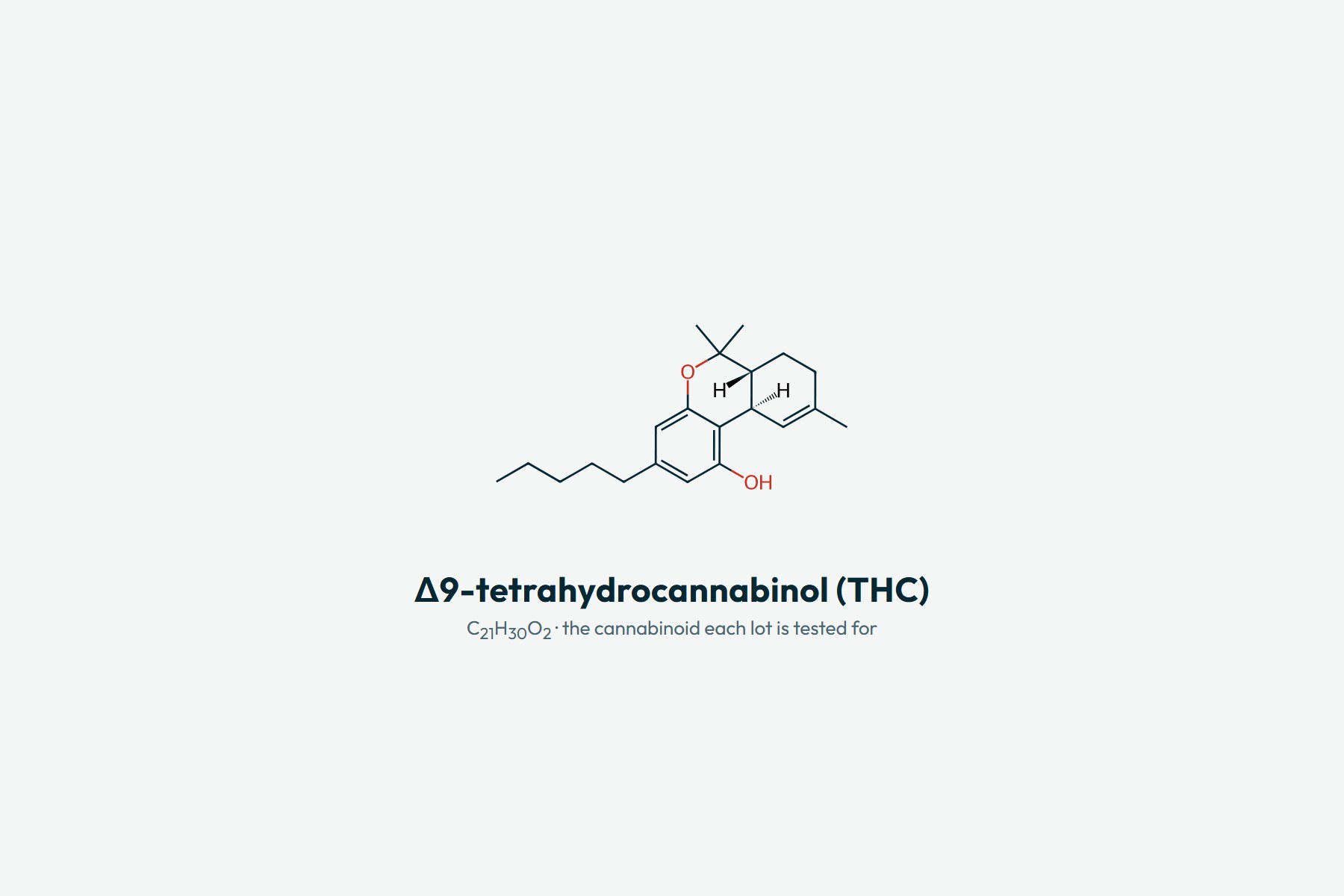
The word "Total" has a defined meaning. Each figure is the quantity of THC the product could yield, taking into account the potential to convert THCA into THC. The Regulations define that potential as the maximum amount of THC that would be obtained if the THCA converted with no further degradation of THC. So the line states the most THC the product could account for, not only what was present in neutral form when it was tested.
The unit on the line is information in itself. An edible states milligrams because it is sold as a quantity: so much per piece, so much per package. Products sold by concentration are labelled differently. Dried cannabis not in discrete units (section 125) and a cannabis extract for inhalation in discrete units (section 132.11) state "Total THC" in milligrams per gram. A milligram figure describes an amount you are holding. A milligrams-per-gram figure describes how concentrated the material is, and says nothing about a portion until the net weight is read alongside it.
The same pattern repeats for CBD, under "Total CBD per unit" and "Total CBD". The full set of cannabinoid lines, and the tolerance each declared figure is held to, is covered in the Health Canada cannabinoids rules for edible cannabis.
How the THC lines must be printed
Most of the THC label Canada sets out is about typography, and the reason is legibility. Under section 130(3), required label information is printed in black, in a regular-weight, regular-width standard sans serif font without italics, in a single font type, with leading of at least 7 points, on a white background that extends at least 6 points beyond the text on every side. Section 130(1) requires everything on the label in English and in French.
The THC and CBD lines carry four extra requirements on top of that. They must be:
- displayed on the principal display panel, or on each one where English and French have separate panels;
- in bold type;
- at least 6 points away from any other information;
- in a type size of at least 6 points, and no larger than the type used for the health warning message.
The last rule sets a hierarchy. The brand name is held to the same ceiling under section 130(4): it may not be set larger than the warning either. Whatever else is on the front of a package, neither the THC figure nor the brand may outrank the warning in size.
The two THC marks that are not numbers
Two parts of the THC label Canada requires are not numbers at all. The first is the standardized cannabis symbol, a red octagon carrying the letters THC. Section 123(1)(f) requires it on any product containing THC at a concentration greater than 10 μg/g, and Health Canada's packaging and labelling guide describes its purpose plainly: to inform and warn consumers that the product contains THC. The file is obtained from the Minister rather than redrawn, and section 131 prohibits anything on the label that resembles it.
The second is the warning box. Section 123(1)(e) requires one of the messages published in Health Canada's Cannabis Health Warning Messages. The current version of that document came into force on March 12, 2025 and has a separate set for edible cannabis products. Three of the messages in that set tie the risk they describe to the amount of THC in a product. Under section 123(4) the messages rotate, so that each appears, as far as possible, on equal numbers of containers of each brand in a year. Two packages of the same product can therefore carry different warnings, and both are correct.
The box itself is specified to the point of colour values. Section 130(6) puts it on the principal display panel, on a yellow background of C=0 M=0 Y=100 K=0, inside a solid black border of at least 1 point with at least 6 points of space inside it. The word "WARNING" is in upper case and bold, the first sentence is bold, and the type is at least 7 points. The only attribution allowed is "Health Canada / Santé Canada", in the bottom right corner of the box.
What the THC lines leave out
The THC label Canada prescribes is deliberately narrow. It does not state a serving size, it does not say what THC does, and it does not say how the figure was established. The figure is still not a design estimate. Every THC quantity on a legal label comes from laboratory analysis of the lot in that package, and the lot number printed elsewhere on the label is what connects the two. How that analysis is required and who releases the lot is set out in how cannabis testing works.
For a manufacturer, all of this is fixed before a label is drawn. Our products are packaged to the labelling rules, with the excise stamp, the standardized cannabis symbol, the health warning, the lot number and the licence holder all present, and cannabinoid content is verified by laboratory analysis on every lot. The THC lines on the front of the package are the shortest part of that work and the part with the least room for interpretation, which is exactly what they are for.